
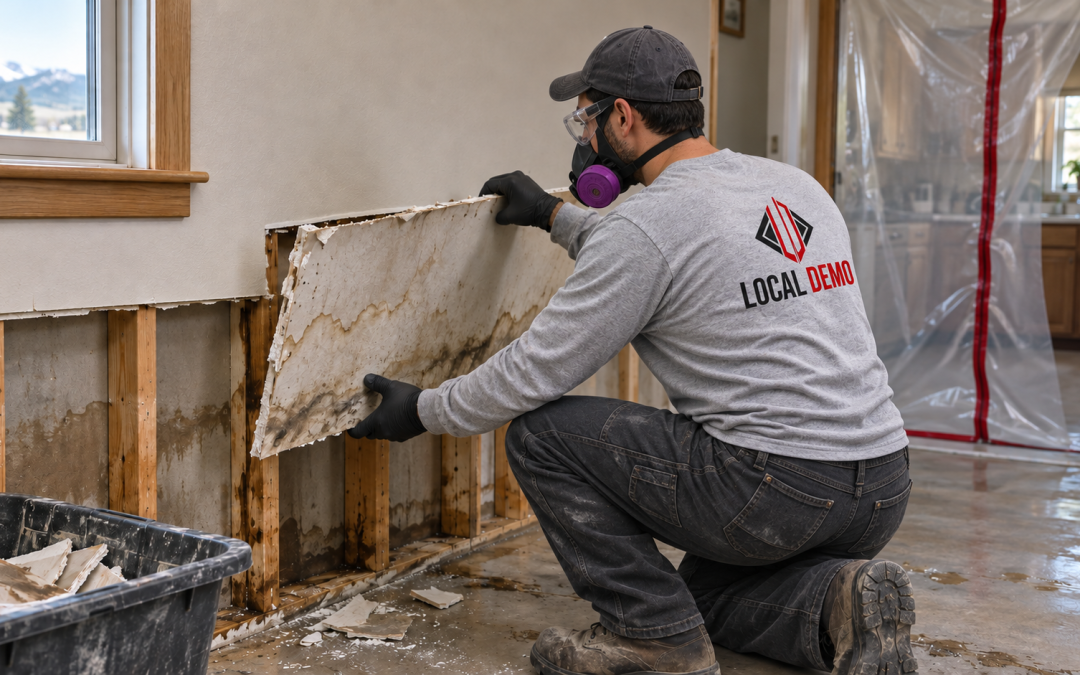
The leak is fixed, but the room isn’t usable. The carpet is soaked, the baseboards are swollen, and a stain is spreading across the ceiling below. Your plumber is done, and your rebuild contractor can’t start yet.
Short answer: a selective demolition crew removes the damaged materials. It’s the step between stopping the water and rebuilding. That crew clears accessible standing water, contains the area, cuts out damaged drywall, insulation, flooring, and cabinets, and hauls the debris so drying and repairs can start.
Local Demo does that removal work for homes, rentals, and commercial spaces across Bozeman and Southwest Montana: Gallatin, Park, Madison, Jefferson, Broadwater, and Meagher counties. We don’t dry structures or rebuild.
This guide covers who handles each phase, what your removal proposal should spell out, and what to have ready when you call.
Request a removal assessment · Call (406) 595-0227
Who handles each phase after a leak?
Most water losses involve three or four trades. Confusion about where one stops and the next starts is what stalls the job.
| Phase | Who usually handles it | What it covers |
| 1. Stop the source | Plumber, roofer, appliance tech | Repairs the pipe, roof, or supply line |
| 2. Remove damaged materials | Selective demolition crew (Local Demo) | Accessible standing water, containment, cutting out drywall, insulation, flooring, and cabinets, debris haul-off |
| 3. Dry and verify | Restoration or drying contractor | Equipment, moisture readings, sign-off that cavities are dry |
| 4. Rebuild | General or restoration contractor | New insulation, drywall, flooring, cabinets, and finishes |
Before approving removal, ask your team two things: who decides the area is dry enough to close, and who tells the next trade it can start. Removing material doesn’t prove the structure is dry.
Do you already have a restoration contractor or GC? Send their contact and removal instructions with your request. We’ll work to their boundaries.
When should you call for a removal assessment?
You don’t need a full repair estimate first. Call when:
- Finishes are damaged, and you don’t know what needs to come out
- Your restoration contractor needs access behind walls or under flooring
- Wet debris is keeping the next trade from starting
- Several rooms or tenant spaces are affected
- You want a written scope before anyone opens a wall
Does all the wet drywall have to come out?
Not always. For clean-water leaks, the EPA’s guidance says you can dry drywall in place if it isn’t visibly swollen and the seams are intact; otherwise, remove it. Wet insulation and contaminated water call for a different approach. A stain alone shouldn’t set the cut line. See how we handle this on our water damage removal service page.
What should a water damage removal proposal include?
A good proposal tells you exactly what’s authorized before anyone cuts a wall. Never approve a line that just says “remove water damage.”
| Item | What to confirm in writing |
| Rooms and cut lines | Which rooms, surfaces, and components. Kitchen leak: flooring only, or toe kicks, cabinets, and adjacent walls too? Ceiling leak: how big an opening? |
| Basis for the scope | Visible conditions, an existing assessment, or your restoration contractor’s instructions |
| Standing water | Whether accessible water removal is included, and what must happen first |
| Protection | How floors, doors, counters, and routes that stay are covered. See containment and surface protection. |
| Occupied spaces | Which areas stay in use, and how work zones and debris paths are kept apart |
| Debris | Includes loading, hauling, and disposal. Belongings, appliances, and unrelated junk quoted separately. |
| Change approvals | Who can approve expanded removal, how it’s documented, and how it changes the price |
| Assumptions and exclusions | Listed, not implied |
Change approvals matter most when an owner, property manager, GC, and restoration company are all involved. Agree on one approver before work starts.
What drives the price of water damage removal?
Square footage is only the start. Two same-size rooms can price very differently.
- Materials: pulling carpet is quicker than removing cabinets or layered flooring
- Access: stairs, tight halls, and long carries to the trailer add time
- Protection: occupied homes and finished routes need more prep
- Extent: one wall opening vs. several rooms
- Debris volume: hauling and disposal scale with what comes out
- Hazards: suspected mold, asbestos, or contaminated water change the work
- Scheduling: restricted hours and trade sequencing
For more on interior removal pricing, see our Montana interior demolition cost guide.
What if you find mold or old materials behind the wall?
Tell us about suspected mold, odors, or visible growth before work starts. Mold changes containment and may need its own mold remediation scope. More in our guide to mold removal before cleanup begins.
In older buildings, drywall joint compound, flooring, and ceiling texture can contain asbestos. Test before disturbing them. Local Demo provides asbestos abatement in-house, so a positive result doesn’t mean finding another contractor.
What to have ready when you call
- Address and building type, plus roughly when it was built
- The source, and whether it’s stopped
- When the damage was found
- Photos from safe, accessible spots
- Affected rooms and visible damage
- Any remaining standing water
- Occupancy, parking, and access limits
- Contacts for contractors already involved, and any written assessment
For commercial properties, add the management contact and tenant scheduling limits.
Request a written scope from Local Demo
Tell us where the water came from and which areas were affected. We’ll schedule a walkthrough and put the proposed work in writing so you know what needs to come out and what’s included before work begins.
Local Demo serves Bozeman and communities across Southwest Montana, including Gallatin, Park, Madison, Jefferson, Broadwater, and Meagher counties.
Request a removal assessment · Call (406) 595-0227
FAQs about water damage removal
Will you work with my restoration contractor or adjuster’s plan?
Yes. Share their removal instructions, and we’ll scope to those boundaries and coordinate the handoff.
The leak stopped. Do I still need anything removed?
Possibly. Stopping the leak doesn’t dry the materials. Have the affected areas assessed rather than relying on their appearance.
Can you handle just one room?
Yes. Describe the room and anything around it when you call. Final boundaries follow actual conditions.
Does your estimate confirm insurance coverage?
No. A proposal describes work and price. Confirm coverage and documentation requirements with your insurer.
Can we stay in the house during removal?
Often, yes. We use sealed containment and protected paths. If an area must stay off-limits, we’ll tell you before work starts.
Do you rebuild afterward?
No. We remove and prepare. Your restoration or construction contractor handles the rebuild.